

Agentic Commerce: Are you ready for AI Agents?
Over the past few weeks, Agentic Commerce (ACO) has gained serious momentum.
Shopping agents are becoming more capable, product data is moving into the spotlight, and the key question is gradually shifting from “What might AI agents be able to do someday?” to “What do merchants need to do today so that agents can actually understand their products?”
And for that, we’re bringing back an old friend: our favorite coffee machine, Dolce Vita.
Imagine you’re selling it.
Your product page says:
“Premium coffee machine for an exceptional coffee experience. Modern design meets innovative technology.”
Sounds like e-commerce. But what does it actually tell us?
Now a potential customer asks their shopping agent:
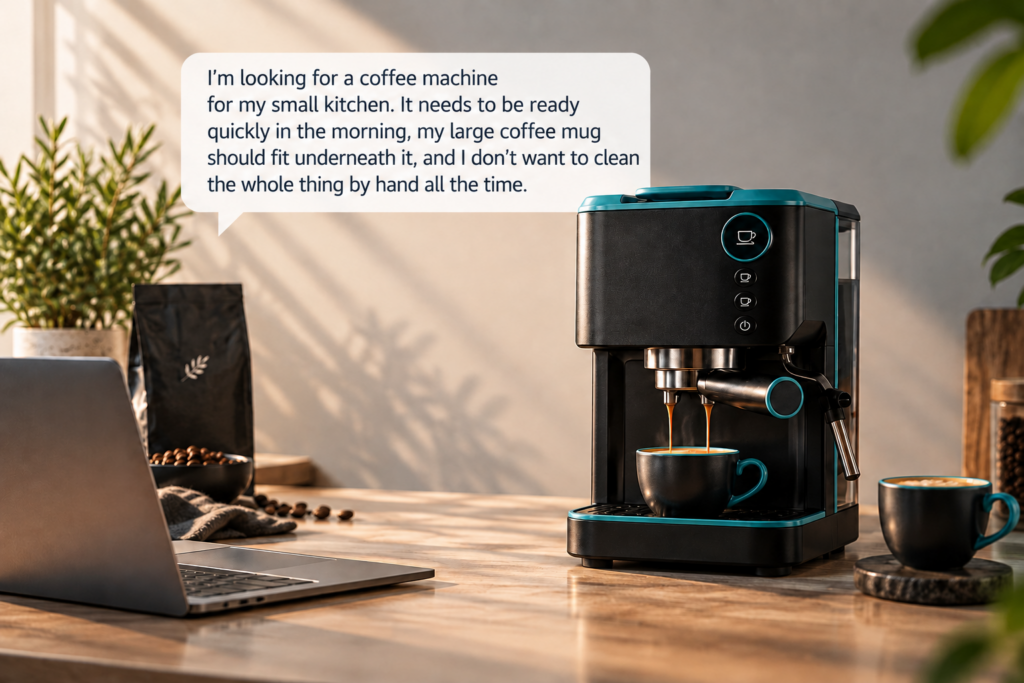
“I’m looking for a coffee machine for my small kitchen. It needs to be ready quickly in the morning, my large coffee mug should fit underneath it, and I don’t want to clean the whole thing by hand all the time.”
Suddenly, very different information matters.
- How big is the machine?
- How long does it take to heat up?
- What is the maximum cup height?
- Which parts can be removed?
- Are they dishwasher-safe?
This is where e-commerce is changing significantly.
Merchants no longer need to answer these questions only for a human reading a product detail page. A shopping agent also needs to find the information, understand it, and match it to a specific customer requirement.
Shopping agents can already take requirements, preferences, and budgets into account, research products, and compare them based on relevant attributes.
For those of us working in e-commerce, that’s “almost” old news by now.
But it’s still not the fully autonomous shopping experience that some Agentic Commerce presentations suggest.
And that distinction matters.
Agentic Commerce Today Is Primarily a Decision-Making Problem
When people talk about Agentic Commerce, it’s easy to imagine a personal AI agent that independently searches for products, compares them, places an order, and pays.
The infrastructure for this is already being built.
OpenAI is developing the Agentic Commerce Protocol as part of this new commerce infrastructure.
Google is working on the Universal Commerce Protocol.
Stripe is also investing heavily in the technical infrastructure for Agentic Commerce and in helping merchants prepare their existing systems for it.
Technically, a lot is happening. Major companies are working together on the infrastructure.
Consumers are a different story.
Current research shows that people are already using AI for product discovery and decision support. Their willingness to hand over the actual purchasing decision entirely to AI, however, is considerably lower.
That makes Discovery and Consideration at least as interesting right now as an autonomous checkout.
And that’s why merchants should act now instead of waiting for some agent to pull out their credit card on its own.
The relevant shift is already underway.
What Happens When the Agent Doesn’t Know the Answer?
Back to our coffee machine.
The Dolce Vita range has a new model. Let’s call her Ilona.
Ilona is actually ideal for our customer:
- Heat-up time: 35 seconds
- Maximum cup height: 14 cm
- Width: 18 cm
- Removable drip tray
- Removable parts are dishwasher-safe
- Compact design – suitable for small kitchens
There’s just one problem.
This information isn’t fully included in the merchant’s product data.
Maybe customer service knows the maximum cup height. Maybe the heat-up time is buried somewhere in the instruction manual. Maybe the product manager knows which parts are dishwasher-safe.
Or maybe not.
The shopping agent doesn’t know any of this by default.
And that leads to a fairly simple but important conclusion:
Product knowledge that exists only inside a company doesn’t help a shopping agent make a decision.
This is exactly the kind of problem ReFiBuy is currently working on for Amazon Alexa for Shopping in the US.
Amazon product detail pages are analyzed for information gaps. Merchants can then observe whether their products appear for specific shopper prompts, which competitors are recommended, and which information influences the shopping agent’s answers.
That’s interesting because it suddenly makes ACO very practical.
The question is no longer just:
“Does my product rank for ‘coffee machine’?”
It becomes something like:
“Can an agent recognize that Ilona is suitable for a small kitchen and a 13 cm travel mug?”
ACO Doesn’t Mean Writing Product Copy for Machines
There’s another trap here.
You might conclude that product pages should primarily be written for AI agents in the future.
I think that would be the wrong conclusion.
Traditional discoverability doesn’t simply disappear because of Agentic Commerce.
A product still needs to be found and understood before it can even become part of the selection.
Especially if people remain skeptical of AI agents and continue making the final purchase themselves.
So the better question is:
What questions does my product need to be able to answer?
And surprisingly, that brings us back to a very old topic.
What Does Rhetoric Have to Do With a Product Detail Page?
More than you might think.
A good product detail page has never simply been a collection of as many product features as possible.
It has a conversation.
The visitor arrives with a problem, expectations, prior knowledge, objections, and decision criteria.
Good product communication anticipates those questions.
Does this product suit me?
Does it solve my specific problem?
What makes it different from the alternative?
What disadvantages or limitations should I know about?
Can I trust what the merchant is telling me?
Rhetoric therefore answers the following question:
What does the person I’m speaking to need in order to make a purchase decision?
And that’s exactly why Agentic Commerce may make rhetoric even more important.
Because an additional participant can now enter the conversation between merchant and customer.
The customer says:
“I need my coffee quickly in the morning, and my large mug has to fit underneath the machine.”
The agent translates that statement into decision criteria.
Then it looks for products for which it can actually evaluate those criteria.
Our phrase “innovative coffee experience” isn’t much help.
(And, by the way, it isn’t particularly helpful to humans either.)
A maximum cup height of 14 cm is.
That’s where rhetoric, SEO, and ACO come together.
SEO asks:
What exactly is my customer searching for?
Rhetoric asks:
What information does the person I’m speaking to actually need to make a decision?
ACO adds:
Can an agent clearly find, understand, compare, and match this information to a specific user requirement?
The product detail page remains a dialogue.
There’s just an agent sitting at the table now.

Being Agent-Ready Goes Deeper Than That
Structured product data is becoming even more important.
Product feeds and new commerce protocols are designed to give shopping agents access to current information about products, variants, prices, availability, and other attributes.
But a perfectly structured feed doesn’t automatically solve a content problem.
If the feed neatly contains:
marketing_description = Premium coffee machine for the perfect coffee experience
then technically, the dataset looks beautiful.
The decisive customer question is still unanswered.
That’s one of the most important differences between data structure and data quality.
ACO needs both.
A merchant first needs to understand which information actually matters to customers when they make a decision.
Then that information needs to be provided correctly, consistently, up to date, and as unambiguously as possible.
Only then does the technical question arise: how can search engines, marketplaces, and shopping agents access it?
What Merchants Can Already Do Today
Take one important product and collect real questions from customer service, reviews, return reasons, search queries, marketplaces, and sales conversations.
Then turn them into specific buying situations.
For Ilona, for example:
“Which coffee machine is suitable for a kitchen with very little counter space?”
“Which machine can fit my 14 cm travel mug?”
“Which coffee machine is ready to use in less than a minute in the morning?”
“Which machine can I clean without having to wash every part by hand?”
And now comes the uncomfortable part:
Try answering these questions using only the information that is publicly available about your product.
Not what the product manager knows.
Not an internal spreadsheet.
Not something that “everyone in the company knows anyway” or “should be obvious.”
Only what an external agent can actually find.
That’s where information gaps become visible.
You can take the test one step further and give different shopping agents the same questions.
- Does your product appear at all?
- Which alternatives are recommended?
- Which attributes does the agent use for its comparison?
- Which questions can’t it answer?
- And do its statements actually match your product data?
That’s not a complete ACO strategy yet, but it’s a pretty sensible place to start.
What About Services?
This is where things get really interesting!
Because the same logic applies here.
Imagine a website offering communication training.
It says:
“Individual training for sustainable personal development. Benefit from years of experience and practical methods.”
Again, it sounds wonderful.
But now an agent gets this task:
“Find me a one-day, in-person training course in the Stuttgart area for professionals and managers who want to communicate with greater confidence.”
Suddenly, it needs different information.
Target audience.
Location.
Dates.
Duration.
In-person or online.
Group size.
Content.
Price.
Requirements.
Booking options.
Professional qualifications of the trainer.
If this information is missing or merely hinted at across several different pages, you end up with the same problem we had with Ilona.
The provider knows the service is a good fit. The agent recommends what it can reliably understand.
But we need to draw a clear line here between what already exists and what we can infer from current developments.
For physical products, things are considerably further along. Concrete product feeds, shopping interfaces, and new commerce protocols already exist.
There is currently no equally established ACO infrastructure for services in general.
Still, the communication implications are already visible.
Service websites should also be able to answer as clearly as possible:
What do you offer, to whom, where, when, in what format, and under what conditions?
That isn’t exactly a revolutionary new SEO insight either.
What’s new is who may be processing that information in the future.

Conclusion: Agentic Commerce Is Less Exotic Than It Sounds
New protocols, feeds, payment systems, and agent interfaces are being developed right now.
The technical foundation is changing dramatically.
ACO has reached Wall Street, and major corporations are investing billions.
But on the merchant side, a surprisingly large part of the discussion currently leads back to some very basic questions:
- Do I know my customers’ decision criteria?
- Is my product information complete?
- Are my attributes unambiguous?
- Does my data contradict itself across different channels?
- Can someone understand my product without access to my company’s internal knowledge?
- And am I actually answering my customers’ questions – or am I mainly producing marketing copy?
Agentic Commerce forces companies to do something that good rhetoric has always required:
Think from the other person’s perspective.
Except that the other party may no longer be human alone.
Maybe your next customer won’t ask Google for a coffee machine.
Maybe they’ll ask their agent.
And then it would be pretty helpful if Ilona could give them the right answers.
Sources
https://refibuy.ai/articles/refibuy-amazon-alexa-for-shopping-general-availability
https://stripe.com/blog/three-agentic-commerce-trends-nrf-2026
https://stripe.com/en-de/guides/how-to-get-ready-for-agentic-commerce-in-an-evolving-landscape
https://openai.com/index/powering-product-discovery-in-chatgpt
https://developers.openai.com/commerce/specs/file-upload/products
https://help.openai.com/en/articles/12911370-using-shopping-research-in-chatgpt?utm_source=chatgpt.com
https://developers.googleblog.com/under-the-hood-universal-commerce-protocol-ucp
https://stripe.com/at/sessions/2026/machine-payments-and-the
https://www.gartner.com/en/newsroom/press-releases/2026-05-27-gartner-survey-finds-consumers-want-ai-shopping-help-but-not-ai-purchase-decisions
https://www.mckinsey.com/capabilities/quantumblack/our-insights/europes-agentic-commerce-moment-decision-influence-is-here-execution-is-coming?utm_source=chatgpt.com
https://www.aboutamazon.com/news/retail/amazon-agentic-ai-gen-ai-shopping