

Agentic Commerce: What Happens When Humans Are No Longer the Only Ones Shopping?
Your next customer is AI.
Sounds a bit like science fiction at first.
But it isn’t anymore.
For years, we’ve been optimizing product pages for people and algorithms. Keywords, attributes, images, reviews, A+ Content, and PPC are all part of everyday e-commerce.
We want our products to be found. We want to show customers why a product meets their needs. And ideally, we want them to click “Buy.”
Now there’s another audience:
AI agents.
ChatGPT can already research and compare products based on specific requirements. It can draw on product data from retailers, publicly available information, and other retail sources. Products can be compared by price, features, and customer reviews, for example.
And that’s where things get interesting for retailers.
Because what happens when humans are no longer the only ones who need to understand my product page?
What Is Agentic Commerce?
Agentic commerce (ACO) refers to e-commerce in which AI agents take over tasks within the purchasing process on behalf of a person.
That can start with product discovery.
Instead of opening ten different online stores and comparing products manually, users describe what they’re looking for. An AI system researches suitable options, compares their features, and helps them decide.
And the process now goes even further.
OpenAI offers Instant Checkout within ChatGPT for certain merchants and products. Google is also developing an infrastructure called the Universal Commerce Protocol (UCP), allowing agentic systems to communicate with merchant systems throughout the shopping journey, from product discovery to purchasing and beyond.
On Amazon in the US, Alexa is already engaging customers in conversations to help them find suitable products.
But what I find most interesting isn’t actually the checkout.
Something important happens much earlier:
In many cases, part of the product selection process takes place before the customer even visits my product page.
And for that to work, an AI agent needs to understand my product.
Our Rucksack Is Back
Let’s return to the business rucksack from my article about product pages.
E-Commerce Product Pages: Why I Don’t Start with Keywords
Someone might type the following into Google or Amazon:
17-inch laptop backpack
Now let’s give an AI agent a slightly different task:
“I’m looking for a lightweight backpack for the office. It needs to fit my 17-inch laptop, be water-resistant, cost no more than €100, and contain no leather.”
Suddenly, simply including the keyword “laptop backpack” somewhere in the description isn’t enough.
The agent needs information it can use to evaluate the product.
Does it fit a 17-inch laptop?
How much does the backpack weigh?
What material is it made from?
Is it water-resistant?
What’s the current price?
Is it in stock?
What do customers think of it?
And is there another product that meets the requirements even better?
This brings me right back to traditional product pages.
An AI agent needs to understand:
- What kind of product is this?
- Who is it suitable for?
- What features does it offer?
- What problem does it solve?
- What makes it different from alternatives?
Interestingly, these are almost exactly the same questions a potential buyer would ask.

SEO Is Dead. Time to Optimize for ACO?
Nope. 😉
Agentic commerce brings new terminology with it. ACO, GEO, AI visibility, and probably quite a few more acronyms to come.
But we don’t need to throw away the e-commerce playbook.
SEO has always been about making content accessible and understandable to search engines. Now retailers need to consider another question:
Can an AI system recognize when my product is a good match for a specific request?
That adds two important questions to the traditional “How do I get found?”
How do I get understood, and when do I get recommended?
This changes quite a lot, but it doesn’t make the existing fundamentals worthless.
Agentic Commerce Is Basically Back to Basics
What does an AI system need to compare products effectively?
For example:
- Complete product attributes
- Clean and unambiguous product data
- Clear product descriptions
- Specific use cases
- Up-to-date prices
- Accurate availability information
- Clearly defined variants and compatibility
- Reviews and other trust signals
Sounds suspiciously like good e-commerce, doesn’t it? 😉
And that’s one of the most interesting things I’ve discovered while exploring agentic commerce.
We’re talking about AI agents, new protocols, and a potentially new way of shopping online.
Yet we quickly find ourselves returning to an old question:
Is our product data actually good enough?
ChatGPT already provides a practical example of why this matters. Its shopping assistant can use merchant data through the Agentic Commerce Protocol, access publicly available product information, and compare products based on that information. OpenAI mentions price, features, and reviews as possible comparison criteria.
A data field that once sat quietly somewhere in the backend, gathering digital dust, could suddenly become an important factor in product selection.
Sounds Great. So Will AI Buy My Washing Machine Tomorrow?
I’d keep an eye on that order yourself for now. 😄
Because we need to distinguish between two things.
AI-assisted product discovery is already a reality.
Today, I can tell ChatGPT what kind of product I need. The system can ask follow-up questions, conduct research, compare products, and put together recommendations based on my requirements.
The next step already exists, too. ChatGPT can offer Instant Checkout for eligible products from participating merchants. OpenAI initially launched this feature in the US and continues to expand the underlying commerce infrastructure.
Google is working in parallel to integrate agentic capabilities more deeply into the shopping process. UCP is intended to provide a common language for AI agents, merchants, and other participating systems. In May 2026, Google also introduced Universal Cart as another component of agentic shopping.
That still doesn’t mean consumers will hand over all their shopping to autonomous agents tomorrow.
There’s a pretty big difference between:
“Which washing machine would suit my household?”
and:
“Choose one, buy it, and tell me when it’ll arrive.”
But the technical infrastructure is beginning to close that gap.
OpenAI, Google & Co.: Agentic Commerce Is Becoming Real
This is where the theoretical discussion gradually turns into actual infrastructure.
OpenAI originally developed the Agentic Commerce Protocol (ACP) together with Stripe. The protocol enables collaboration between AI agents and merchant systems and is now also being used for product discovery.
Merchants can provide product feeds and promotions through this infrastructure, among other things. According to OpenAI, Shopify product data is already integrated into ChatGPT through the Shopify Catalog.
Google is pursuing a similar approach with the Universal Commerce Protocol (UCP). This open standard is designed to connect different systems throughout the customer journey. Google explicitly mentions discovery, purchasing, and post-purchase support.
What interests me is where all of this is heading.
Until now, retailers have primarily needed to make their products available to online stores, marketplaces, search engines, and advertising systems.
Now another layer is emerging where product information gets processed:
AI agents.
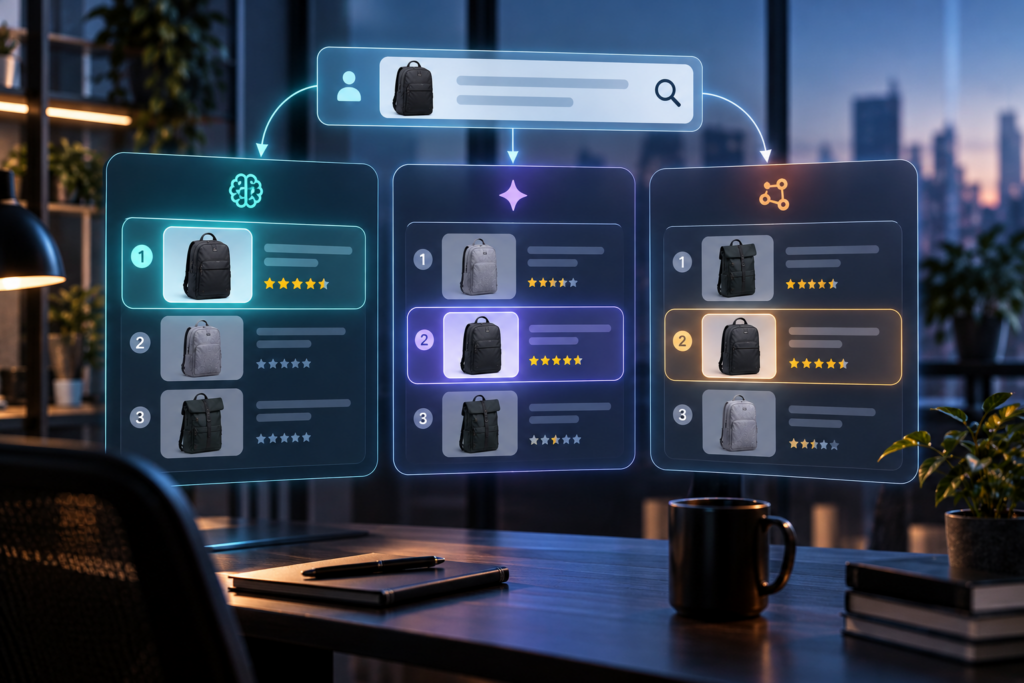
Great. But How Do I Know Whether My Product Is Visible to AI?
This is where things get considerably more difficult.
Over the years, we’ve built up a fairly comprehensive set of tools and metrics for traditional SEO.
Rankings. Impressions. Clicks. CTR. Sessions. Conversion rate.
AI visibility now has its own tools, prompt tracking, and various scores.
But what does an AI visibility score of 73 actually mean?
73 out of what?
For which prompt?
On which model?
With what context?
And will I get the same result the next time I ask?
That doesn’t make these metrics useless. They can help track developments over time or compare competitors using the same methodology.
I just wouldn’t confuse them with traditional search rankings.
Even within ChatGPT, product selection depends on the specific request and its context. If a user specifies a budget, price becomes more important. Different requirements can bring entirely different products to the top.
That’s why I’m interested in another question:
For which realistic customer questions does my product appear, and why?
Our backpack provides a good example.
I could test:
“Which business backpack is suitable for a 17-inch laptop?”
Then:
“Which of those weighs less than 800 grams?”
And finally:
“I don’t want leather, and my budget is €100 maximum.”
If my product appears in the first response but disappears in the second, I’ve learned something.
Maybe the weight information is missing.
Maybe the information isn’t clear enough.
Or maybe my product genuinely doesn’t meet the requirement.
I find that much more interesting than a nice-looking score on its own.
What Does Agentic Commerce Mean for Retailers Today?
Before everyone rushes to optimize all their product pages for agentic commerce, I’d start by looking at the fundamentals.
Are my product attributes complete?
Are variants and compatibility clearly described?
Are prices and availability accurate?
Does my product page answer the questions customers actually ask?
Can a system identify which use cases my product is suitable for?
And is important information hidden exclusively in images or PDFs when it could also be provided as structured product data?
Then I’d start testing.
With realistic questions and actual prompts.
With different requirements.
And across different AI systems, provided they’re relevant to my target audience.
But there’s something important to remember: even the companies developing these systems don’t know exactly what agentic commerce will look like in five years.
What they can do today is identify trends and draw conclusions from the available data.
Conclusion: A New Player in E-Commerce
How big will agentic commerce become? We’d need a crystal ball for that.
How much of their shopping will people eventually delegate to AI agents?
Nobody knows yet.
But we can already see the developments taking shape.
ChatGPT researches and compares products. Merchants can provide product data directly to these systems. OpenAI and Google are building protocols that allow AI agents to interact with commerce platforms. In certain cases, the process already extends all the way to checkout.
For retailers, I don’t see an entirely new discipline emerging from this…
…at least not yet.
Clean product data, complete attributes, understandable content, specific use cases, and up-to-date information were already fundamental to good e-commerce.
What’s changing is who’s reading that information.
In the past, my product primarily needed to be understood by people and search algorithms.
Now there’s someone else:
Their AI agent.