
Why Do So Many AI-Generated Texts Sound the Same?
Have you ever come across posts like these on social media?
“It’s not about selling more. It’s about reaching the right customers.”
“The problem isn’t declining revenue. It’s the moment most retailers realize their old structures are falling apart.”
“The real problem isn’t that old structures eventually collapse. It’s the moment people realize that most have already fallen silent.”
“Success is no longer an end in itself.
For many, it takes:
Courage.
Conviction.
Clarity.
Those who understand this no longer seek recognition — and become an inspiration to others.”
I regularly come across phrases like these, particularly on LinkedIn. In posts, comments, and professional discussions.
And I recognize them from my own AI-generated drafts.
The examples are deliberately exaggerated. Still, they’ll probably sound familiar to many readers: artificial contrasts, vague generalizations, grand statements, and a dramatic structure designed to turn a simple thought into a profound revelation.
I use ChatGPT myself for drafting, research, and reviewing my writing. I regularly find phrases that I subsequently delete or rewrite. Sometimes I don’t even notice them until the final read-through.
That’s why I’m interested in why language models so often fall back on these patterns, how much we can actually infer about a text’s origin from its writing style, and what technical AI detection tools can achieve.
Four Writing Patterns I Keep Encountering
Artificial Contrasts
“It’s not about X. It’s about Y.”
It sounds like an important insight. But often, nobody was questioning X in the first place. The contrast only exists because of the way the sentence is constructed.
A contrast like this can be rhetorically effective. When it appears in every other paragraph, it loses its impact.
Vague Generalizations and Hedging
“Many companies may possibly realize too late that…”
Who are “many companies”? What are they realizing too late? And why only possibly?
Words such as “can,” “might,” and “possibly” certainly have their place. Qualifications are particularly important when dealing with uncertainty or scientific claims.
It becomes noticeable when several of these expressions appear in a single sentence without a clear reason, or when a statement is so vague that it barely says anything at all.
Overly Dramatic Language
“And this is where the crucial point lies.”
“This is where the real transformation begins.”
“This was the moment they fell silent.”
Big words, very little concrete information. Often, you could delete the entire sentence without losing anything.
Artificial Drama
One idea, ten paragraphs. Every sentence gets its own line. And at the end, a supposedly profound revelation that could have been expressed in two sentences.
Short paragraphs can make texts easier to read. But when every sentence gets its own dramatic entrance, even an everyday observation starts to sound like the announcement of a historic decision.
Why AI-Generated Texts Sound So Similar
Language models generate text by calculating likely continuations based on the preceding context. During training, they learn which words, sentence structures, and expressions commonly appear in particular contexts.
If I ask a language model to write a professional LinkedIn post about communication, I’m giving it a fairly general task.
The model has to decide how to open the post, which arguments to present, and how to conclude. Without further guidance, it tends to fall back on familiar writing patterns.
Suddenly, a post about leadership reads just like one about e-commerce, fitness, the future of work, or flowerpots.
Only the terminology has changed.
The Problem Starts with the Prompt
Let’s say I want to write a post about product presentation in e-commerce.
I could ask an AI:
“Write a professional and persuasive LinkedIn post about why good product presentations are important.”
The result will probably be usable. But it could just as easily have come from any other e-commerce expert.
After all, the AI doesn’t yet know what I actually think about the subject.
For example, if I’ve noticed that product descriptions often list technical specifications while leaving important customer questions unanswered, that observation belongs in the prompt.
I can also explain how I would address the problem and what I’ve learned from my own experience.
That gives the text a specific direction. Even so, ChatGPT may still introduce phrases I would never use myself.
That’s why I review and edit every draft before publishing it.
Can You Recognize AI-Generated Text by Its Writing Style?
Imagine reading a post and spotting several typical phrases.
You’re pretty sure: ChatGPT wrote this.
Maybe you’re right.
But perhaps a human wrote it after regularly reading similar posts and unconsciously adopting their style.
Or perhaps someone thoroughly revised an AI-generated draft and left only two of the original phrases intact.
Writing style alone therefore isn’t a reliable way to determine where a text came from.
We can recognize that a text sounds generic. But that doesn’t tell us whether AI was involved in creating it, or to what extent.
Can specialized software do a better job?
AI Detectors: How Are They Supposed to Work?
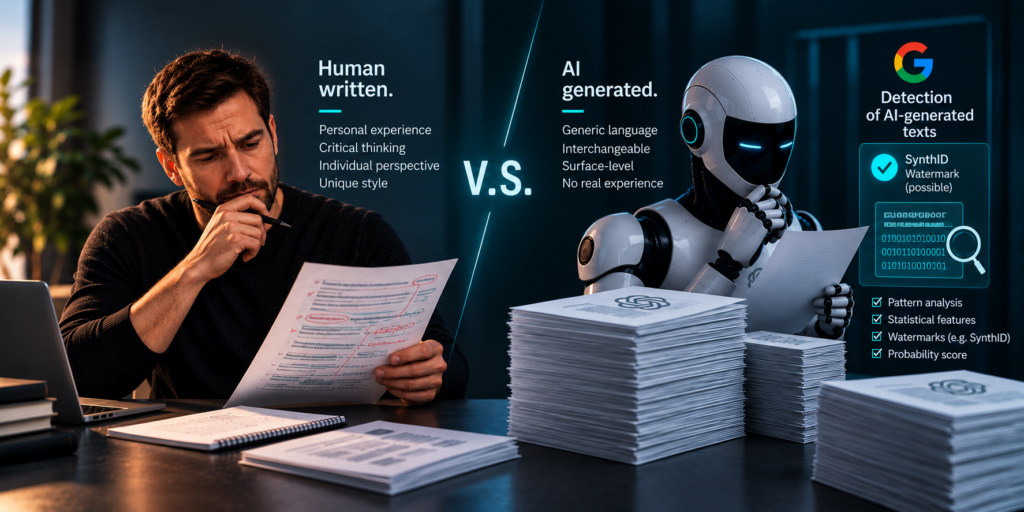
AI detectors attempt to estimate whether a text was likely generated by a language model based on statistical characteristics.
Depending on the method, they may examine word sequences, linguistic predictability, or other patterns that can differ between human-written and machine-generated text.
Subsequent editing can also change a detector’s assessment.
A person can rewrite an AI draft, add paragraphs, or replace particular expressions. Conversely, a text written entirely by a human can have a very regular and predictable structure.
There are also differences between languages, types of text, and the language models being used.
A detector that performs well on a particular type of English AI-generated text won’t necessarily achieve the same results with a short German LinkedIn post.
Things become particularly problematic when a statistical assessment turns into a personal accusation.
A displayed result of, say, “90% AI” doesn’t automatically mean that the text’s origin has been established with 90% certainty. Among other things, we’d need to know how the detector calculates that figure and how reliably it has been evaluated for that particular type of text.
Anyone trying to assess a text’s origin needs considerably more than a single percentage.
What About Watermarks for AI-Generated Text?
With images, visible watermarks or metadata can provide clues about their origin. With text, things aren’t quite so simple.
A technical watermark for AI-generated text can be created, for example, by having a language model deliberately introduce a particular statistical pattern when selecting words.
This pattern is normally invisible to readers. A detection method designed for it can identify the pattern under suitable conditions.
Such methods are currently the subject of scientific research and practical development.
Google, for example, has introduced SynthID Text, a method that embeds a watermark during text generation.
However, that doesn’t mean every AI-generated text can be detected using this technology.
How reliably a watermark can be detected depends, among other things, on the length of the text and the method used. SynthID Text, for example, may remain detectable after minor changes. But extensive rewriting or translation can make detection considerably more difficult.
If a detection tool finds no watermark, that doesn’t prove a human wrote the text.
And even a detected watermark doesn’t automatically tell us how much editorial work went into the text afterward.
Do We Even Need to Be Able to Detect AI-Generated Text?
For me, this is the central question.
When I read a professional article, I want to know whether its claims are accurate, whether its examples make sense, and whether the author actually has something worthwhile to contribute.
A text written entirely by a human can be superficial, inaccurate, or boring.
A text created with AI assistance can convey real experience, be thoroughly researched, and carefully edited.
The way a text was produced tells us relatively little about its quality on its own.
Of course, there are situations where its origin matters. For example, when independent work is required for an examination, when a text is deliberately presented as a personal experience, or when disclosure is legally required.
But when reading an ordinary professional article, I’m primarily interested in what it says and whether I’ve actually learned something I didn’t know before.
What I Do Differently When Writing with AI
I’ll continue using AI as a tool because it saves me a lot of time.
But I also want to recognize my own voice in the texts I publish.
That’s why I’m thorough when editing.
I remove phrases that sound good but add no useful information.
I replace general claims with concrete examples. And I check whether a sentence actually expresses what I mean or merely sounds as though something important ought to be said at that point.
Sometimes the best edit is surprisingly simple: deleting an entire paragraph.
Other passages require me to think again. What am I actually trying to say? How do I know this? And what example would I give someone sitting across from me in a conversation?
AI can help me organize my thoughts.
But I still have to come up with the thoughts in the first place.
Even when I provide specific instructions, I don’t always get the writing style I want. Certain phrases keep returning despite my having explicitly ruled them out several times.
That’s why I don’t assume that a good prompt can replace editorial work.
Banning hedging words altogether would be just as unreasonable. What matters is whether a qualification is necessary for accuracy or merely weakens a statement without adding anything.
Conclusion: Good Writing Takes More Than a Good Prompt
We can recognize certain phrases commonly found in AI-generated texts. But not reliably.
And as AI continues to develop, it’s worth asking how long those patterns will remain recognizable at all.
Linguistic patterns can provide clues. Technical detectors and watermarks can offer additional information under certain conditions. None of these methods can answer every question about a text’s origin on its own.
For my own work, I draw a different conclusion:
I pay closer attention to what I write.
If a paragraph sounds as though it could appear unchanged beneath a hundred other LinkedIn posts, I ask myself whether it belongs in my article at all.
And if I read my own text and think, “I’d never say it like that,” the sentence goes.
No matter how convincing ChatGPT thinks it sounds.