E-Commerce Product Pages: Why I Don’t Start with Keywords
I have a new product in front of me. Everything looks good so far.
Technical specifications ✓
Images ✓
Maybe there’s even an old product description ✓
And of course, I have a keyword list ✓
I could start writing now.
But I don’t.
Because there’s still one fairly simple question I haven’t answered:
Why should I buy this?
For me, that’s where a good product page begins.
Not with the highest-volume keyword. Not with keyword density. And not with figuring out how to squeeze as many search terms as possible into the copy.
First, I need to understand the product.
What Am I Actually Selling?
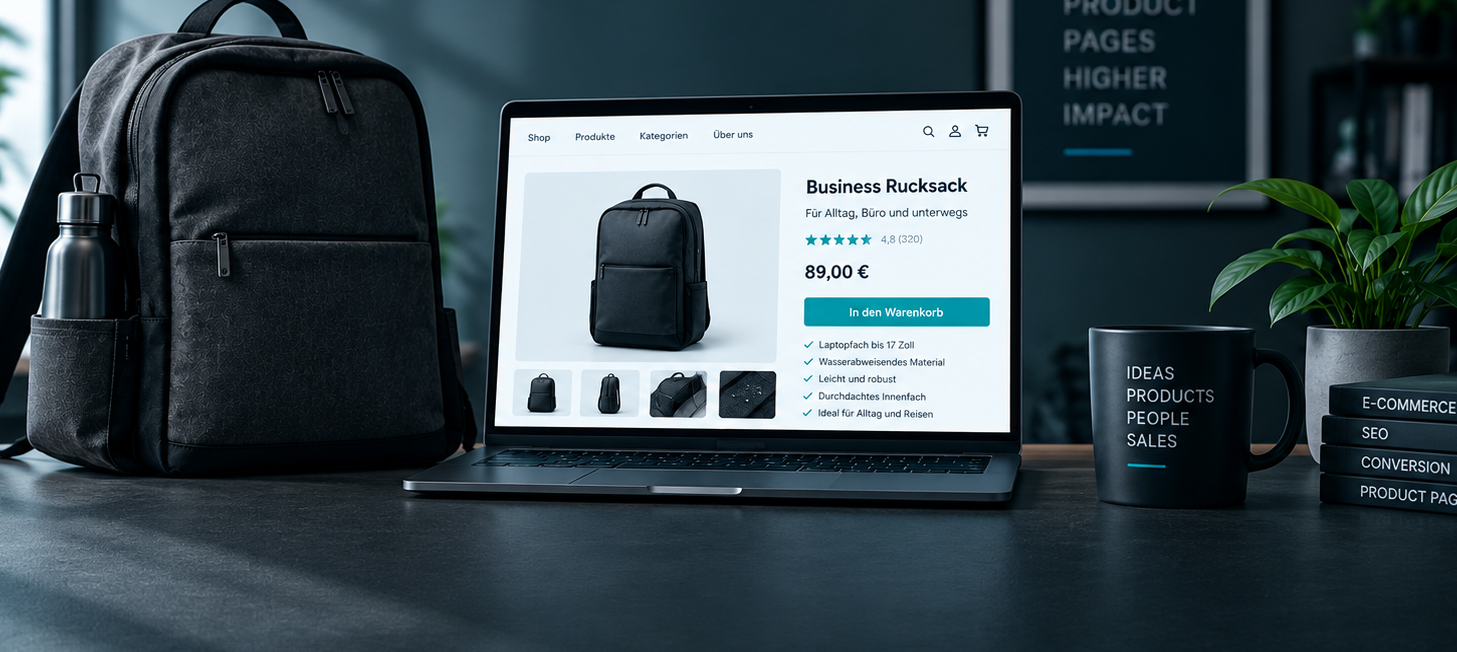
Let’s take a backpack.
20-liter capacity. Water-resistant material. Padded laptop compartment. Weighs 750 grams.
Great. Now I know four product features.
But as a buyer, I have different questions.
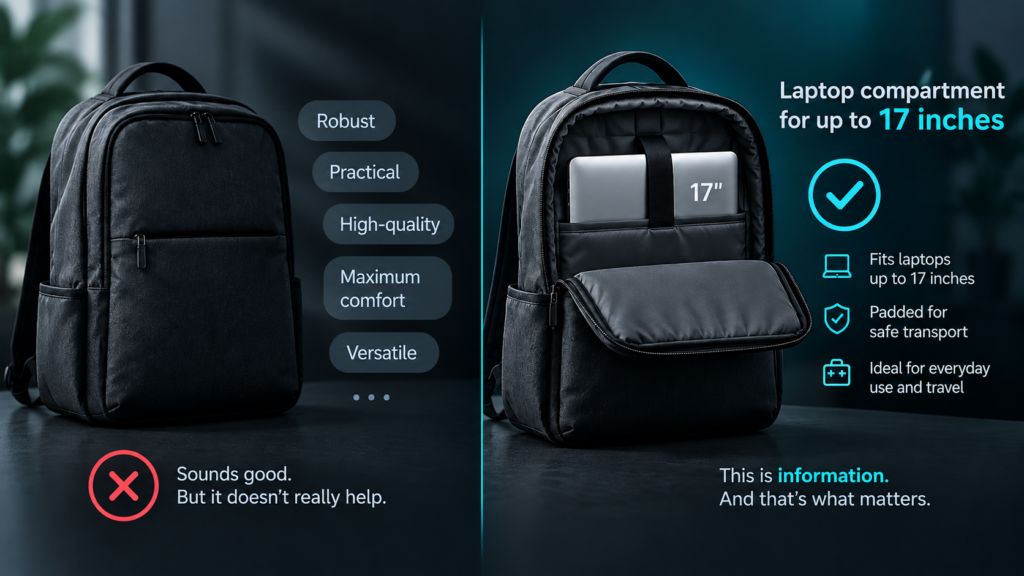
Will my 17-inch laptop fit?
Is there enough room for my water bottle, headphones, and all the other stuff I carry around?
Can I use it for my daily commute to the office?
What happens if it starts raining on my way to the train station?
How long will it last with regular use?
Will the color go with my new winter jacket?
That’s where the real work on a product page begins.
I need to connect the information I have about the product with the questions a potential buyer might ask.
⭐ Sounds pretty obvious. But it makes a huge difference.
And yet, I constantly come across product pages describing items made from “premium materials,” featuring “innovative functionality,” and naturally delivering “maximum comfort.”
Whatever that’s supposed to mean.
A Product Description Isn’t a Specification Sheet Full of Adjectives
Technical specifications belong on a product page.
But they don’t automatically answer the customer’s questions.
And adding three adjectives to a product feature doesn’t suddenly turn it into a compelling reason to buy.
Take this:
Padded laptop compartment
And turn it into:
Durable, padded laptop compartment for maximum everyday comfort.
Sounds more impressive.
But I still don’t know whether my 17-inch laptop will fit.
➤ Then just tell me.
Not every product feature needs a creative benefit statement. Sometimes a simple, specific piece of information is exactly what the customer needs.
Dimensions. Materials. Compatibility. What’s included. Weight. Connections. Fit.
Which details matter depends on the product.
And, more importantly, on the person who’s supposed to buy it.
Sounds Great. But We Still Need People to Find Our Products.
Of course.
» Now we get to the keywords.
For me, SEO is just as much a part of a good product page as clear product information. After all, even a fantastic product page won’t do us much good if it’s buried on page 37 of the search results.
Keyword research just isn’t where I start.
In fact, once I understand the product, keyword research becomes much more interesting.
Because a keyword list tells me more than search volume.
It shows me how people search for a product.
When someone searches for a “17-inch laptop backpack,” a “lightweight backpack,” or a “backpack for work,” those searches tell me something about what might matter to that person.
So I go back to my product page.
Does it actually say what size laptop will fit?
Is the weight listed?
Do the images and text show how the interior is organized?
Sometimes keyword research reveals a gap I overlooked during my initial product analysis.
I find that far more interesting than worrying about how many times a particular phrase should appear in the copy.
So What Does That Look Like in Practice?
Let’s stick with our backpack.
Suppose my keyword research shows that people are specifically searching for a lightweight laptop backpack for work.
Now I could try to work those terms into my product description as cleverly as possible.
Or I could first check whether my page answers the questions behind those searches:
➥ Will a 17-inch laptop fit?
➥ How much does the backpack weigh?
➥ How much storage space is left after putting the laptop inside?
➥ Is the material water-resistant?
➥ How is the interior organized?
When I answer these questions properly, something rather useful happens:
Relevant keywords often find their way onto the product page naturally, because I’m writing about the very things potential customers are searching for.
An SEO-Optimized Product Description Isn’t Keyword Tetris
Of course I use relevant keywords.
I want my product page to be found.
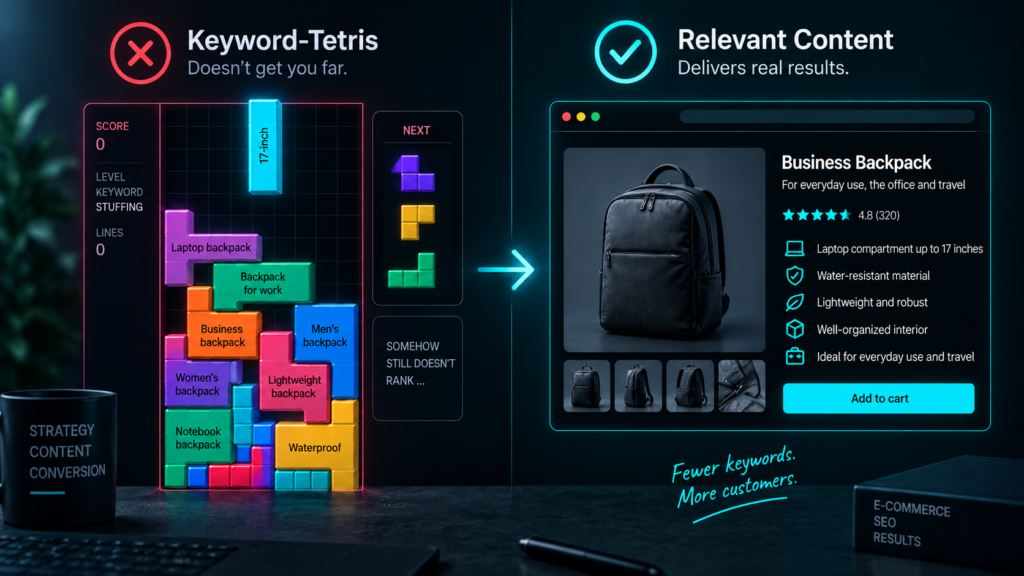
But keyword research shouldn’t be followed by a game of keyword Tetris.
One more keyword in the heading. Another in the next paragraph. We’ve only used this one three times. Surely we can squeeze it in somewhere.
That’s not the kind of product description I want to read.
And it’s certainly not the kind I want to write.
A relevant keyword should appear where it makes sense, both linguistically and in terms of content.
If a search term also describes an important product feature or answers a relevant customer question, even better.
Then the information serves both the search engine and the person reading it.
Great, They Found Us. Now What?
Let’s assume our SEO efforts have worked.
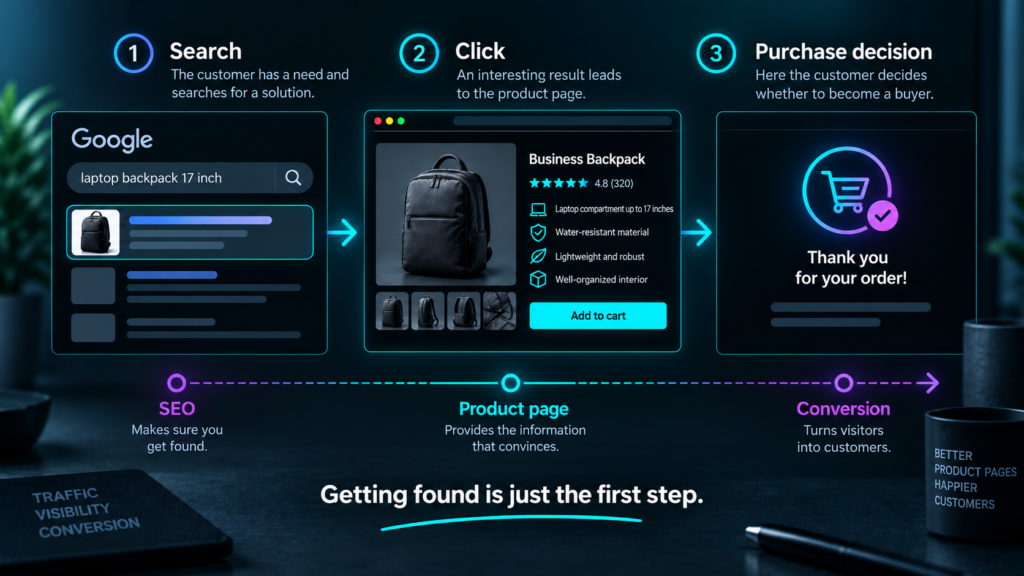
Someone searches for our product, finds it, and clicks through to the product page.
Job done?
Not quite.
Now the page has to do its actual job.
Visitors need to understand what they’re getting. They need to find the information that matters to their buying decision. And ideally, they shouldn’t have to leave because an important question remains unanswered.
▶️ This is where SEO becomes a conversion question.
A product page can rank for relevant keywords and still perform poorly when it comes to sales.
On the other hand, I could create the best product presentation in the world. If nobody finds it, that won’t help much either.
I need both.
So Where Do I Start with My Next Product Page?
Not with an SEO tool. 😉
Take a closer look at the product and ask yourself a few fairly simple questions:
➥ What exactly am I buying here?
➥ Why might I want this particular product?
➥ What would I need to know before spending money on it?
➥ What would I ask if a salesperson were standing in front of me?
➥ Which of those questions does my product page currently leave unanswered?
Only then would I bring in the keyword data.
Now I can examine how people actually search for the product and its features. Maybe the research confirms my assumptions. Maybe it reveals something important I’ve overlooked.
Either way, I now have a solid foundation for the title, product description, images, technical information, and everything else on the product page.
Conclusion: Understand the Product First, Then Look at Keywords
I’ve been working in e-commerce for over ten years. Tools, platforms, and search algorithms have changed quite a bit during that time. And with AI Search and Agentic Commerce, we’re now entering another phase.
But the fundamental question I ask when working on a product page hasn’t changed:
Why would I want to buy this?
That also determines the order in which I work:
❇️ Understand the product
❇️ Identify customer questions and needs
❇️ Add relevant information to the product page
❇️ Compare that information with keyword data
❇️ Optimize the content for visibility and conversion
SEO and a good product description are, of course, essential parts of the process. Keyword research helps me better understand customers and the information they’re looking for.
Because if I can’t explain why someone should buy my product:
Then I have a product page problem.